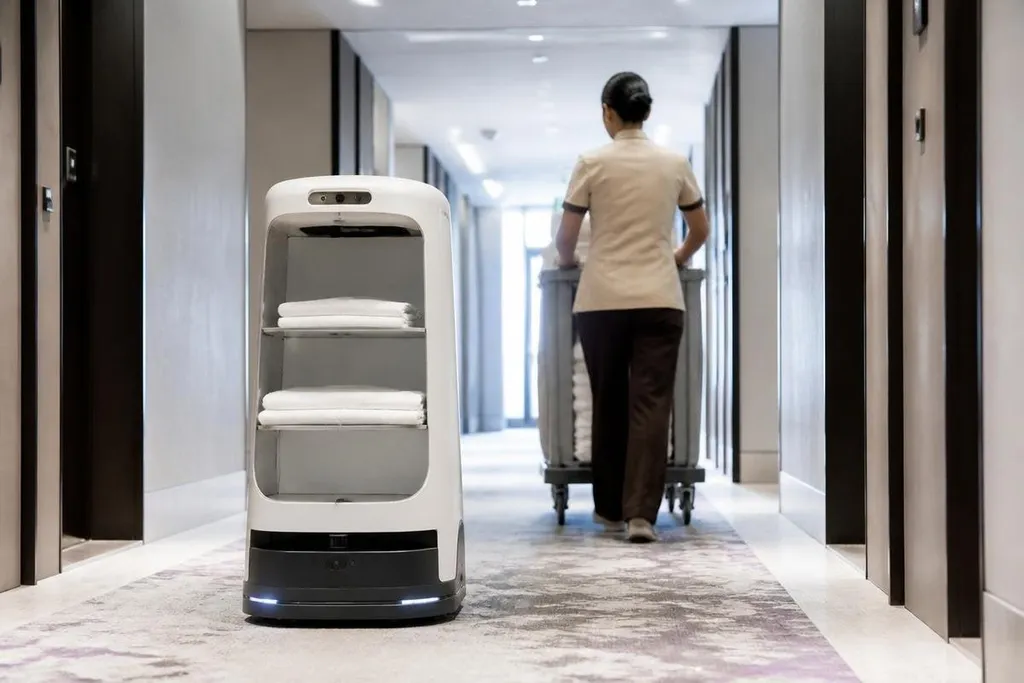
Service robots are moving into places where people already work: hotels, hospitals, restaurants, shops, and public buildings. The hard part is no longer making a robot move. It is making one complete a useful task when the floor, people, objects, and instructions keep changing.
- A robot that carries a tray still needs safe handoffs, clear routes, and a way to recover from mistakes.
- Cameras help a robot see objects, but force sensors help it know when contact has gone wrong.
- Buyers need proof from real tasks, not a polished clip of one successful run.
What service robots must do
A service robot links several jobs in one system. It must sense the area, plan a route, move through it, handle an object, and report a problem when the task cannot continue. A failure in any one part can stop the whole job.
That makes service robotics different from a fixed industrial arm. An arm in a factory can repeat the same motion beside a controlled workstation. A hotel delivery robot faces open doors, blocked hallways, lifts, guests, and carts in places that change during the day.
The robot also needs a clear job. “Help staff” is too vague to test. “Carry sealed meals from the kitchen to a room and return to the charging point” gives a buyer something to measure. The test can then include travel time, delivery errors, staff calls, battery use, and recovery after a blocked route.
The hard work sits between the parts
A camera can detect a cup. A gripper can close around it. The system still needs to judge whether the cup is empty, hot, slippery, or placed too close to the edge of a table. That decision links perception, control, and the robot’s physical design.
The same issue appears in movement. Wheels can work well on smooth floors, while legs can cross steps and uneven ground but need more control. Neither choice solves the task by itself. The robot’s shape must match the building, the objects, and the people around it.
Software updates can improve route planning or object detection, but they cannot fix a body that cannot reach the required shelf.
A larger battery can extend a work period, yet it can also add weight and make the robot harder to stop. Service robots are systems of trade-offs, so the task should come before the machine.
That trade-off gives buyers a practical question: what did the robot do, where, and under what load? Service robot reports from Robot24.com can put the model, task, test site, and date beside the result.
What buyers should ask for
A demonstration proves that a robot completed one attempt. It does not prove that the robot can do the same work for a full shift, across several rooms, with people nearby. Ask for the test conditions and the failures, not only the success rate.
The useful details include the robot’s payload, operating time, turning space, charging method, noise level, and safety response. A hotel may care about lift access and quiet movement. A hospital may care about cleaning, door control, and what happens when a person steps into the robot’s path.
Price also needs careful treatment. The purchase cost may cover the body and software, while installation, mapping, service visits, replacement parts, and staff training sit outside that number. If those costs are missing, the total is not ready for a buying decision.
The open question is remote help. Many robots can ask a person to solve a task they cannot handle alone. That can make a small fleet useful, but the labor needed for those interventions must be counted in the operating plan.
A practical buying checklist
Use this list before a pilot or purchase:
- Name the task: Write the start point, end point, object, handoff, and finish condition.
- Set the test area: Include doors, people, floor changes, blocked routes, and the spaces the robot will use.
- Record failures: Count stops, remote interventions, damaged items, missed deliveries, and recovery time.
- Check the full cost: Add installation, mapping, training, support, batteries, and replacement parts.
- Set a human fallback: Decide who responds, how fast they must act, and how many robots one person can support.
- Choose a stop rule: End the pilot if safety events, task errors, or staff workload stay above the agreed limit.
A service robot earns its place when it completes a defined task with little human help and a cost the site can carry. The next useful measure is not how many robots are announced, but how many can keep working after the first blocked door, dropped object, or software fault.